A request can finish even when its sender never receives the answer. The next attempt has to account for that uncertainty.
Picture an automation that books a visit in another system. The request arrives and is saved, but the connection drops before the confirmation comes back. The first system only sees a timeout.
If it tries again as though nothing happened, it books a second visit. The scheduled job works, the remote service works, and the customer still gets two messages. The example is hypothetical: it describes a failure the design has to allow for, not an incident on any project of ours.
A timeout does not prove nothing happened
An operation has more states than "worked" and "failed". It may not have started, may still be running, may have finished, or may have finished without the sender being able to confirm it. How that last case is handled decides whether a retry recovers the process or doubles its effect.
Before choosing a tool, write down which actions can be repeated harmlessly and which need to recognise an earlier attempt. Checking availability can be repeated ten times. Creating a booking, charging a card or sending a message cannot.
What does idempotency mean in an automation?
It is the property of an operation that, repeated, produces no extra effect: booking the same visit twice leaves one booking. You get it by giving each operation a stable identity and keeping what is known about its result, so a retry recognises the earlier attempt instead of repeating it.
The operation needs a stable name
For a retry to recognise the earlier attempt, both have to carry the same name. In the example, "book the requested visit with reference V-204" is a useful identity. "Book a new visit" with a different identifier on every attempt gives no way of knowing it is the same request.
Some providers build this into their contract. Stripe documents idempotency keys: repeat a request with the same key and it returns the first result instead of running it again. That is one provider's contract; you cannot assume every API does the same.
Read the destination's contract: which operations support it, how long the reference is kept, and what happens when the same key arrives with different data. A function's name proves none of those things.
Leave a trail you can decide from
A process someone can operate has to answer what it tried to do and what it knows about the result. For the hypothetical visit we would keep a reference for the operation, its state and whatever reference the destination returns, once it returns one:
Operation: book visit V-204
Local state: result awaiting confirmation
Last attempt: connection timed out
Remote reference: not yet known
Next step: check or reconcile before booking again
It is an example record, not a full implementation. Saving a row before calling another service does not make the two operations atomic: you still have to decide what happens if the process stops between them. And if two workers can run the same operation at once, mutual exclusion has to rest on a guarantee from whatever stores or runs the work, not on a check in a dashboard.
Where it shows up on our automation page
Our automation page shows a live log: twelve lines that follow a sample case from start to finish. It is nobody's real system; it is how we build these processes, told with an invented case.
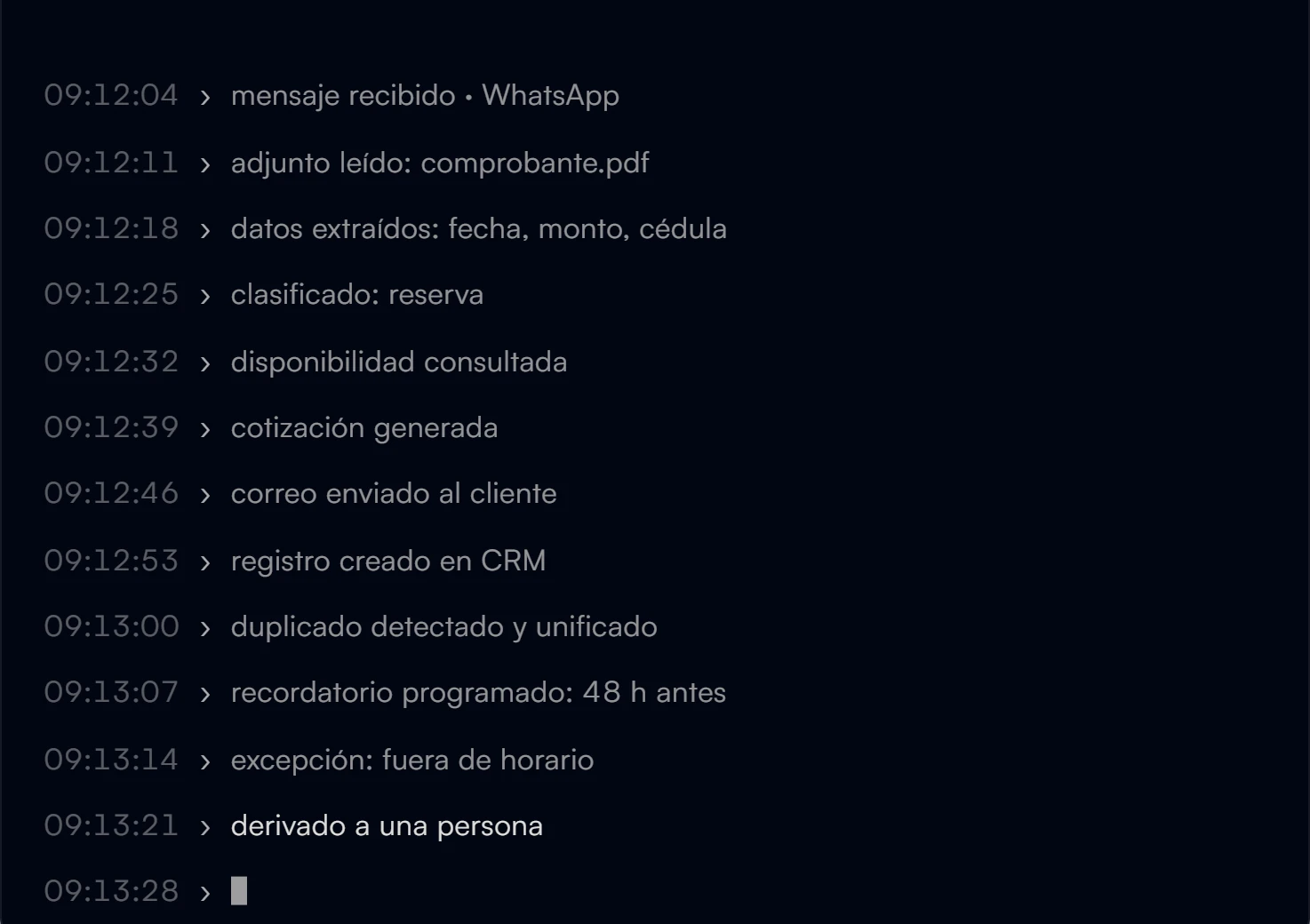
Three of those lines are about exactly this problem. "Record created in CRM" is followed by "duplicate found and merged": the case does not trust that the contact was new, it checks and merges the two records. "Reminder scheduled: 48 h before" is a future action that must not be scheduled twice if the process runs again. And "handed to a person" closes the case when something turns up that the rules do not cover.
The log is also the trail from the previous section, made visible. Each line says what was done and with what, so whoever operates the system can read where a case stopped without guessing. How we built that showcase without stock photos is in an automation page with no stock photos.
It happened in our own code
The problem is not peculiar to integrations. It turns up anywhere one event can arrive by two routes, and it has turned up on this site.
Between pages, kavaliero.com closes a curtain of red pixels and opens it on arrival. As it opens, it releases the new page to start its entrance. There were two routes to that release: one halfway through the wipe and a backstop at the end. If a page mounted between the two, the second signal ended a wait that was no longer its own, and on our About page the title rose 100 to 350 milliseconds ahead of its 3D figure.
The fix was the fix for any idempotent operation: both routes share one guard, and the curtain releases once, whichever way the signal arrives. A similar case: in development, React deliberately runs certain effects twice to flush out exactly this, so a page's wait is taken once per mount and remembers that it has been taken.
These are small faults on a website, but they have the same shape as a duplicate booking: an effect that does not know it already happened. If it exists in the code for an animation, it exists in the code for a business process.
Our form, and the cost we accept
Our contact form disables its button while it sends, and the label changes to "Sending". That stops the double click from someone who thinks nothing happened, which is the most common duplicate of all.

It carries no idempotency key. If the response were lost after the email provider had accepted the message, and the person sent it again, we would receive two emails. For an enquiry that is a cost we accept: a repeated email in our inbox harms nobody.
For a booking, a payment or a message to a customer, the same decision would be a mistake. The useful question is not "can this be duplicated?", because almost anything can, but "what does a duplicate cost?". The difference between an accepted request and an email someone has read is in the contact form does not end at Send.
When the destination will not help, a person decides
If the destination's API can look things up by your own reference, the process can check before booking again. If it cannot, the honest way out is to send the case for review whenever the outcome is uncertain. Do not turn a provider's limitation into an "exactly once" promise the integration cannot keep.
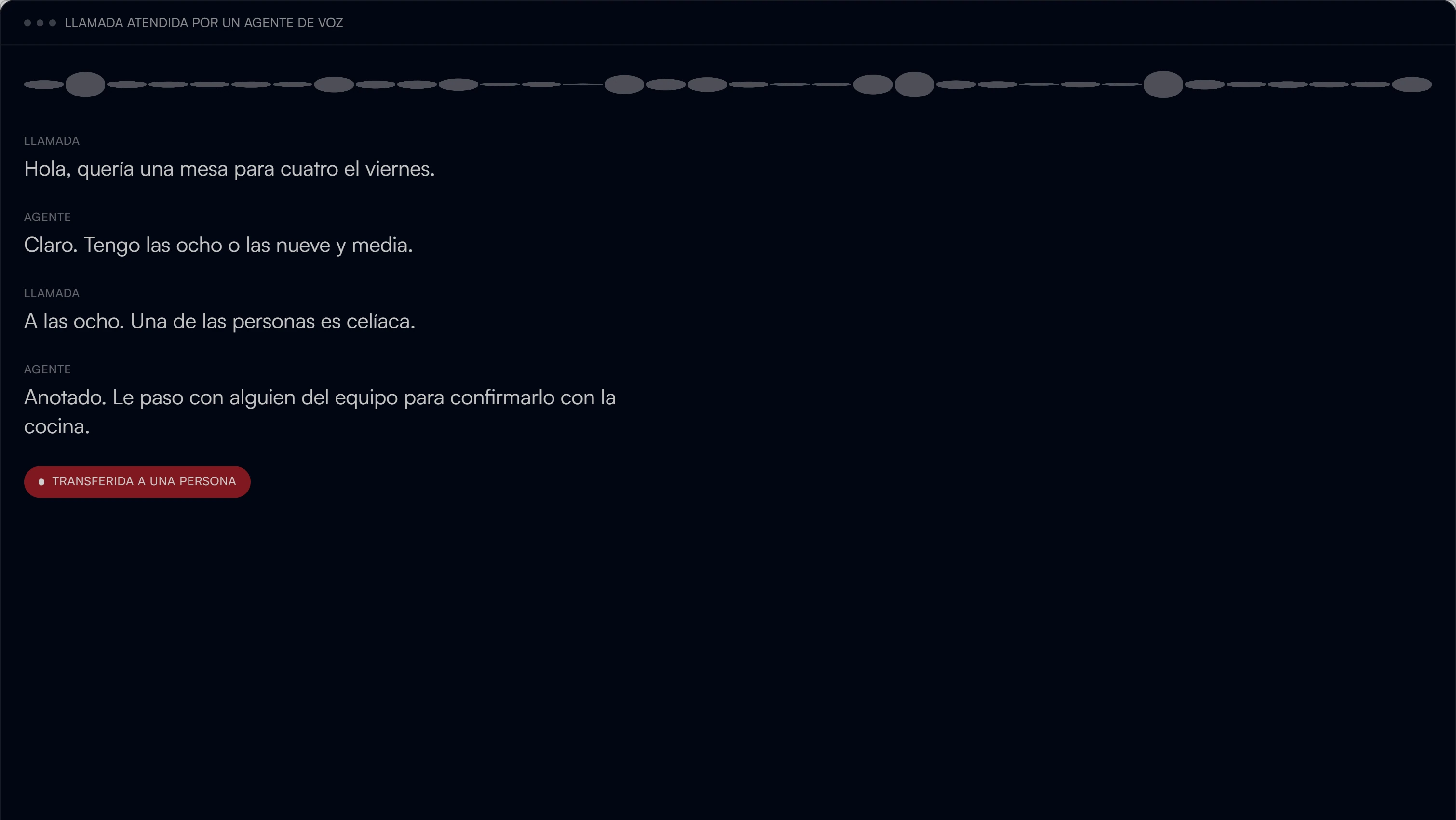
On the automation page we call this agreeing in advance what happens when something fails: who receives the case and with what context. The sample call on the same page ends that way: the voice agent answers, takes the details and, faced with something that needs confirming, passes the call to a person.
The operator's dashboard has to tell failure from uncertainty. A red row with a "Retry" button invites a repeat. If the system does not know whether the visit was booked, the button has to say so or run a check first. States such as pending, running, confirmed, rejected and awaiting reconciliation help when they match the real process.
A compensating action needs care too. Deleting a duplicate booking does not unsend the email the customer already received. Restoring the data and undoing its consequences are not always the same thing.
Break the response in a test environment
Duplicates never show up in a demo, because in a demo the network works. You have to provoke them:
- Repeat one operation with the same identity and count the effects at the destination.
- Cut the response after the destination has accepted the operation.
- Fire two attempts at once and see how the collision is resolved.
- Repeat with changed data to see whether the system spots the conflict.
- Check what a person can do when a result is left unconfirmed.
- Count the real effects, messages included, not only the rows in the dashboard.
An automation is ready when it can explain its own uncertainty and offer a way to resolve it. Choosing which process to automate first is in what to automate first, and what to leave alone; testing AI against the hard cases is in keep the cases the demo leaves out. Details like these are part of the cost of making it dependable.
Related projects and insights
Do you have a process that cannot afford to do things twice? Tell us where it hurts and we will start there.
FAQ
Can retrying a failed request duplicate an action?
Yes, if the action went through and only the response was lost. The process has to recognise the earlier operation or check its result before repeating an effect.
Do all APIs support idempotency keys?
No. Read each provider's contract and, where the guarantee does not exist, design a prior lookup, a reconciliation step or a review by a person.
Which actions are dangerous to repeat?
The ones with effects outside the system: creating bookings, taking payments, sending messages or scheduling reminders. Checking a status can be repeated harmlessly; creating something cannot.
Is disabling the button while sending enough?
It prevents the double click, the most common duplicate, but not a response lost after the destination accepted the operation. For an enquiry it may be enough; for a booking or a payment the operation needs a stable identity.
What should an automation do when it does not know whether something went through?
Say so. Check the result if the destination allows it and, if not, mark the case as awaiting reconciliation and pass it to a person with its context, rather than repeating the action blind.